
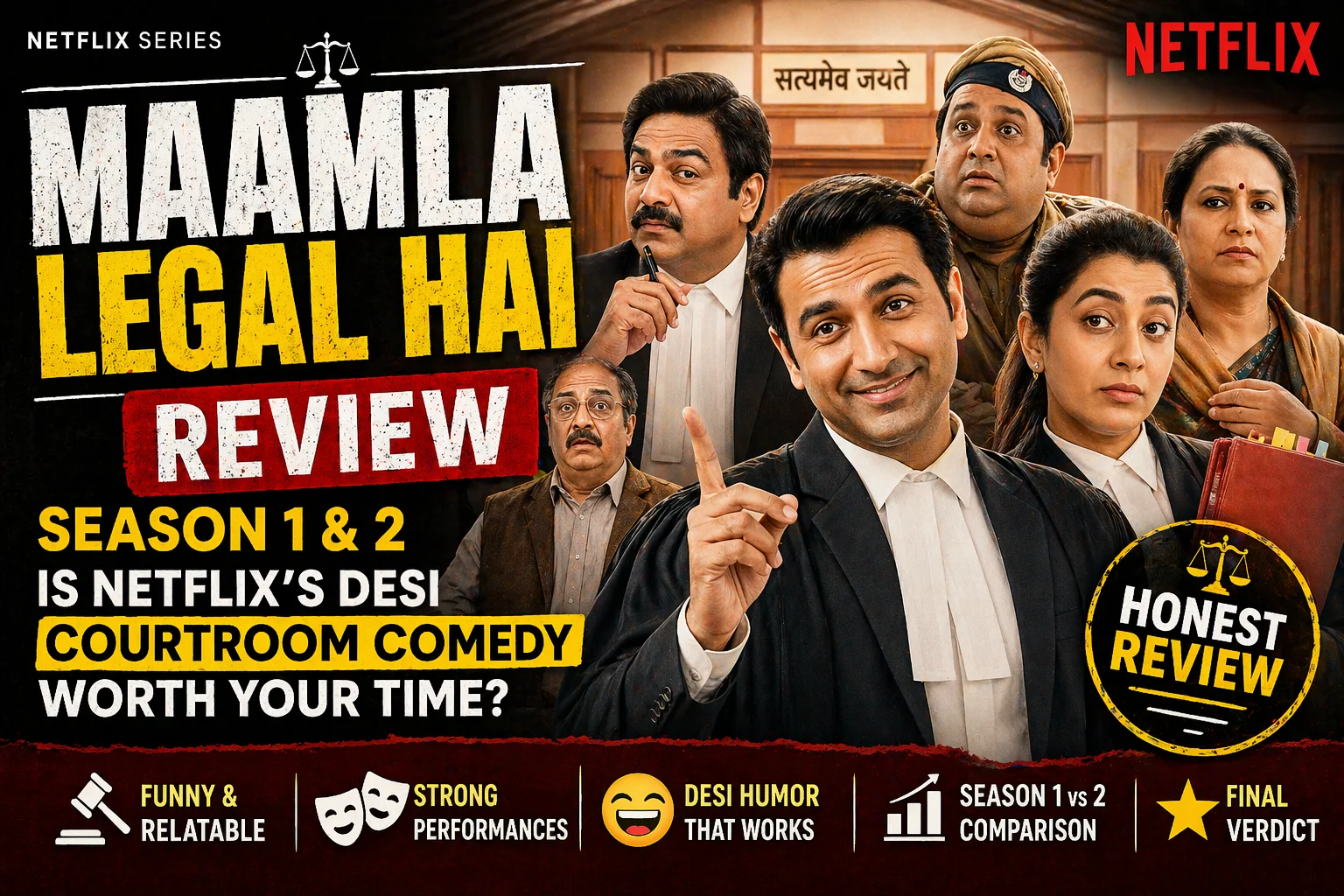
Patparganj’s District Court is chaotic, absurd, and strangely lovable. A full review of both seasons — with honest opinion on what works and what the sequel loses.
Streaming: NetflixS1 Premiere: March 1, 2024S2 Premiere: April 3, 2026Episodes: 8 per seasonRuntime: ~30–38 min eachLanguage: Hindi
Season 1: 4 / 5Season 2: 3.5 / 5IMDb: 7.8 / 10Genre: Legal Comedy · Courtroom DramaCreator: Sameer Saxena
India has a complicated relationship with its courts. We joke about them, we despair about them, and somewhere in that gap between what justice should look like and what it actually does, Maamla Legal Hai found the funniest, most affectionate comedy of recent Indian streaming.
When Season 1 dropped on Netflix on March 1, 2024, it did not arrive with any fanfare. No film-star cameos, no massive promotional push, no viral trailer moment. And yet within days it had quietly climbed into the Netflix Global Top 10 Non-English Series — and stayed in India’s Top 10 for a full four weeks. That kind of sustained word-of-mouth momentum, completely driven by audience enthusiasm, is genuinely rare. It means something.
Season 2 arrived on April 3, 2026 — two years later, with new episodes, new characters, and a significant change to its central dynamic. Does it match the magic of the first season? Mostly, yes. Does it fully recapture it? That is a more complicated answer. This review covers both seasons honestly — what makes this show essential, where it stumbles, and why Ravi Kishan’s VD Tyagi has quietly become one of Indian OTT’s most entertaining characters.
📋 Series at a Glance
Creator / Showrunner
Sameer Saxena
Director
Rahul Pandey
Writers (S1)
Saurabh Khanna, Kunal Aneja
Writers (S2)
Kunal Aneja, Syed Shadan, Mohak Aneja, Tatsat Pandey
Production House
Posham Pa Pictures
Platform
Netflix (India & Global)
Total Episodes
16 (8 per season)
Setting
Patparganj District Court, Delhi
01
What Is Maamla Legal Hai?
The title translates roughly to The Matter Is Legal — a phrase that captures the show’s central joke perfectly. At Patparganj’s District Court in Delhi, almost every dispute, no matter how absurdly petty, ends up as a legitimate legal case. A man sues his neighbour over the shade cast by a tree. A family argues over a disputed recipe. Real estate frauds, bizarre property disputes, cases that make you snort with recognition — because you have heard about something exactly like this happening to someone your parents know.
The show is described as satya durghatnaon par aadharit — based on true incidents. That rooting in real life is part of what gives it its texture. The cases feel plausible, sometimes absurd, always human. Creator Sameer Saxena, who also made Kaala Paani and Jaadugar for Netflix, has a sharp instinct for finding the comedy inside everyday Indian institutional life without ever making it mean-spirited.
At the centre of it all is Visheshwar Dayal Tyagi, known as VD Tyagi or simply Tyagi Ji — a sharp, wisecracking, boundary-pushing lawyer from Season 1 who gets promoted to Principal District Judge in Season 2. His journey from cunning advocate to reluctant upholder of actual justice is the show’s most satisfying throughline, and Ravi Kishan plays him with a relish that makes every scene he is in feel like the best scene in the episode.
“After BC and AD, it is the VD era now.” — Tyagi Ji, Season 2, within thirty seconds of putting on his judge’s robes.
02
Season 1: The One That Started Everything
Season 1 · March 2024 · 8 Episodes
Season 1 introduces us to the Patparganj ecosystem: Tyagi Ji, the slick lawyer who will say and do almost anything to win a case — as long as it keeps him on the right side of technically legal; Ananya Shroff (Naila Grewal), a Harvard-educated new arrival who arrives with high ideals and quickly learns that law school and courtroom reality are entirely different countries; Mahendra Phorey (Yashpal Sharma), the veteran lawyer who has seen everything and is surprised by nothing; and Sujata Negi (Nidhi Bisht), known affectionately as Sujata Didi, who is equal parts scheming and sympathetic.
What the first season gets right — brilliantly, consistently right — is its sense of ensemble. No single character exists purely as a punchline. Every person at Patparganj Court has their own logic, their own set of compromises, their own version of what justice means to them. Tyagi is not a hero or a villain; he is a man who has learned to navigate a system that would chew through someone less resourceful, and he does it with a style that is both maddening and oddly endearing.
The individual case-of-the-week structure works well. Each episode is around 30 minutes — tight, efficient, rarely padded — and the cases escalate beautifully in absurdity without ever losing their grounding in recognisable human behaviour. Episode 3 became an immediate fan favourite and regularly cited as the funniest single episode of the series. The writing by Saurabh Khanna and Kunal Aneja is confident and sharp throughout Season 1, with dialogue that lands cleanly and characters whose voices feel genuinely distinct from each other.
The show also does something quietly valuable: it demystifies the legal process for ordinary viewers without dumbing it down. You come away from Season 1 with a real sense of how district courts function, what the pressures on lawyers and support staff look like on a daily basis, and why the gap between law and justice is not just a philosophical question but a daily lived reality for the people inside those buildings.
03
Full Cast — Both Seasons
| Actor | Character & Role |
|---|---|
| Ravi Kishan | Visheshwar Dayal Tyagi (VD Tyagi) — Lawyer in S1; Principal District Judge in S2 |
| Naila Grewal | Ananya Shroff — Harvard-educated idealist lawyer; moral compass of the show |
| Nidhi Bisht | Sujata Negi (“Sujata Didi”) — sharp, scheming, lovable court staffer |
| Anant V Joshi | Vishwas Pandey — Patparganj Court Manager; comic anchor of the support staff |
| Yashpal Sharma | Mahendra Phorey — veteran lawyer who has seen it all and learned nothing |
| Anjum Batra | Lakhmir Singh Balli (“Mintu”) — Sujata’s chamber partner; eternally bickering duo |
| Brijendra Kala | Supporting lawyer role |
| Tanvi Azmi | Supporting role in S1 |
| Dibyendu Bhattacharya | Kailash Shubhkela — new co-judge; Tyagi’s philosophical foil in S2 S2 New |
| Kusha Kapila | New character addition in S2 S2 New |
| Vijay Rajoria | Jagdish Gupta (“Munshi Ji”) — takes over Tyagi’s old chamber in S2 S2 New |
| Dinesh Lal Yadav | Supporting role in S2 S2 New |
04
Season 2: The Judge Has Entered the Chamber
Season 2 · April 3, 2026 · 8 Episodes
Season 2’s central structural shift is bold and the right call: Tyagi Ji is no longer a lawyer. He has been elevated to Principal District Judge — a promotion that, on paper, should be the culmination of everything he has been working toward. In practice, it turns out that a man who built his entire professional identity on bending, charming, and occasionally strong-arming the system finds it extremely difficult to suddenly become the system.
The episodes are somewhat longer this time — averaging closer to 38 minutes — and the show’s tonal ambitions are broader. Sexual harassment, juvenile justice, the death penalty, gay rights: Season 2 gestures toward heavier subject matter than Season 1 ventured into. The show handles these topics with a light touch that some viewers will find appropriately gentle and others will find insufficiently serious. My honest view is that the comedy framework serves as both the show’s strength and its limitation when it comes to these themes — you can raise the issue without fully exploring it.
The best addition in Season 2 is Dibyendu Bhattacharya as Kailash, the other newly appointed Principal District Judge. Where Tyagi is flamboyant and instinctive, Kailash is measured and pragmatic. Their dynamic — two men who have arrived at the same place through completely different routes — generates the show’s most interesting character work. Bhattacharya is a quietly exceptional actor and he makes every scene with Ravi Kishan feel genuinely alive.
“Maamla Legal Hai Season 2 maintains its predecessor’s frivolity even as it tries to live up to the solemnity of Tyagi’s new position.” — Scroll.in
The Balli-Sujata chamber squabble — over whether their newly acquired shared office should be called “Balli Negi and Associates” or “Negi Balli and Associates” — runs as a background gag throughout the season. It sounds minor but it is actually one of the season’s funniest sustained bits, because Anjum Batra and Nidhi Bisht play the pettiness with such utter conviction that it stops being a joke and becomes a genuine portrait of how humans fight over the smallest available assertion of status when the bigger things are out of their hands.
05
Season 2 Episode Guide
Each episode in Season 2 is named after a legal or moral concept — a deliberate choice that signals the season’s slightly more ambitious thematic intentions:
| Ep 1: Without Fear or Favour | Tyagi adjusts to his new role; the old team scrambles without him |
| Ep 2: Unbiased | Accusations of bias force Tyagi to confront his instincts |
| Ep 3: Balanced | The court takes on a case that divides the team’s sympathies |
| Ep 4: Emotional Attachment | Personal relationships threaten professional lines |
| Ep 5: Juvenile | A case involving a minor raises questions about responsibility and age |
| Ep 6: Act of God | A bizarre dispute tests the limits of what the law can actually address |
| Ep 7: Compromise | Settlements, negotiations, and what gets lost in between |
| Ep 8: Beyond Reform | The season finale — stakes raised, resolutions delivered, at least partially |
06
Season 1 vs Season 2: An Honest Comparison
Season 1 (2024)
Tighter, leaner, more focused. The case-of-the-week format is fresh and the writing has the energy of a show that knows exactly what it wants to be. Tyagi as the charming, rule-bending lawyer is immediately compelling. The ensemble chemistry feels natural and unforced. The show confidently sits in its comic lane without overreaching.
Season 2 (2026)
More ambitious and more uneven. Tyagi’s promotion is the right structural choice, but the show spreads its focus across too many characters. Dibyendu Bhattacharya is a genuine asset. The heavier thematic gestures are admirable but sometimes sit awkwardly next to the broader comedy. A satisfying watch — but less consistently sharp than Season 1.
07
What Works, What Doesn’t
What Works
Ravi Kishan — one of Indian OTT’s most underrated lead performances
Tight, efficient episode lengths that respect your time
Cases rooted in real incidents — absurd but always recognisable
The full ensemble — every character has depth and their own logic
Dibyendu Bhattacharya’s arrival in Season 2 adds genuine texture
Nidhi Bisht and Anjum Batra’s bickering duo — deeply funny throughout
The show never becomes mean-spirited toward the legal system it lampoons
Demystifies courts for ordinary viewers without dumbing down
What Doesn’t
Season 2 spreads its focus too thin across too many subplots
The heavier themes in S2 feel underdeveloped within the comedy format
The S2 finale does not land with the weight the season earns
Music is functional but largely forgettable in both seasons
The initial episodes of S1 take a few episodes to fully find their pace
Some subplots in S2 feel more obligatory than genuinely felt
08
Should You Watch It? Our Honest Take
Absolutely, yes — and the fact that you might not have heard of it until now is part of the point. Maamla Legal Hai is the kind of show that does not arrive with algorithmic thunder. It builds its audience quietly, through actual human recommendation — one person telling another that it made them laugh out loud on a Tuesday evening when nothing else managed to.
It belongs in the tradition of great Indian workplace comedies — the Gullak school of storytelling, where the pleasure comes not from plot twists or spectacle but from spending time with people who feel completely real. The Patparganj Court feels lived-in. You come to know its rhythms, its politics, its specific brand of chaos. By the end of Season 1 you feel genuine affection for characters you might have found mildly irritating in Episode 1, which is exactly what good ensemble television is supposed to do.
Ravi Kishan deserves particular recognition here. He is an actor whose mainstream Bhojpuri film image does not quite prepare you for what he does with Tyagi Ji — which is to make a man who is fundamentally a schemer into someone you root for with complete sincerity. His scene work with Dibyendu Bhattacharya in Season 2 is the best dramatic writing in the show’s run so far, precisely because it allows both actors to operate outside the purely comedic register and find the genuine human weight underneath the jokes.
If you have sixteen hours of combined free time — each episode around 30 to 38 minutes, eight episodes per season — start with Season 1 Episode 1 and do not stop until you have finished both. The total investment is worth it. Patparganj will become a place you will find yourself thinking about when you are not watching, which is the highest compliment you can pay a fictional location.
★★★★☆
Verdict: One of Indian OTT’s Best-Kept Secrets — Go Watch It Now
Maamla Legal Hai earns its place among the finest Indian comedy series of recent years. Season 1 is close to perfect in its genre. Season 2 is a worthy, slightly messier continuation. Ravi Kishan and his ensemble will have you back at Patparganj Court before the second episode ends.
Season 1: 4/5Season 2: 3.5/5IMDb: 7.8/10OTTPlay (S1): 3.5/5Bollywood Hungama: Recommended
Both seasons of Maamla Legal Hai are currently streaming exclusively on Netflix. The show is available with subtitles in 35 languages and dubbed in English, Tamil, and Telugu. For the full cast list and episode ratings, visit the official IMDb page ↗.
Maamla Legal HaiRavi KishanNidhi BishtNaila GrewalNetflix IndiaCourtroom ComedySameer SaxenaPosham Pa PicturesWeb Series ReviewHindi OTT 2026
Disclaimer: This article is an independent editorial review. All information, cast details, episode titles, and factual references are sourced from publicly available platforms including Netflix, IMDb, Wikipedia, Bollywood Hungama, Scroll.in, and verified entertainment news outlets. No copyrighted dialogue, scripts, or proprietary material has been reproduced. This article is written for informational and editorial purposes and complies with Google AdSense content policies.
Published: April 22, 2026 | Category: Web Series Review / Netflix India | Word Count: ~1,250 | IMDb: tt31183656 ↗



Leave a Reply